Affiliate disclosure: As an Amazon Associate, this site earns from qualifying purchases linked in this article.
Perimenopause brings a steep decline in estrogen, which reduces collagen synthesis, thins the epidermis, and heightens chronic low‑grade inflammation — changes that collectively accelerate visible skin aging. These hormonal shifts also impair the skin’s antioxidant defenses, making it more vulnerable to oxidative stress from UV exposure and environmental pollutants.
Curcumin, the primary polyphenol in turmeric, has demonstrated anti‑inflammatory, antioxidant, and collagen‑supportive properties in laboratory and early clinical studies. A narrative review highlights the potential of curcumin combined with collagen and glutathione to enhance dermal health in women with declining estrogen [1], while a systematic review of clinical evidence on turmeric extracts notes modest benefits for various skin conditions [2]. The overall evidence base remains moderate, with many findings derived from small or preclinical studies.
Estrogen Decline and Skin Aging
Estrogen receptors are abundant in fibroblasts and keratinocytes, where the hormone stimulates type I and III collagen production, maintains skin thickness, and regulates matrix metalloproteinases (MMPs) that degrade extracellular matrix. As estrogen falls during perimenopause, collagen content can decrease by up to 30 % within the first five years, contributing to wrinkles, sagging, and delayed wound repair [1]. The same review notes that reduced estrogen also diminishes the skin’s capacity to neutralize reactive oxygen species, creating a pro‑oxidant environment that further accelerates matrix breakdown.
Curcumin’s Mechanisms Relevant to Skin
Curcumin inhibits nuclear factor‑kappa B (NF‑κB) signaling, down‑regulates pro‑inflammatory cytokines such as IL‑1β and TNF‑α, and suppresses MMP‑1 and MMP‑9 expression in dermal fibroblasts, thereby limiting collagen degradation [3]. Its antioxidant activity scavenges free radicals and up‑regulates endogenous enzymes like superoxide dismutase and glutathione peroxidase, which are compromised after estrogen loss.

Research on curcumin nanocarriers shows that particle size influences β1‑integrin overexpression in fibroblasts, a marker of enhanced cell‑matrix adhesion and regenerative capacity, suggesting that optimized delivery can amplify curcumin’s pro‑repair effects [4]. Additionally, a study combining an immunomodulator with antioxidants in smoker women reported reduced monocyte‑driven inflammation, supporting the concept that antioxidant‑rich formulations can modulate skin immune responses [5].
Clinical Evidence from Human Studies
A systematic review of 18 clinical trials evaluating oral or topical turmeric/curcumin for skin health found improvements in measures of erythema, pruritus, and disease severity in conditions such as atopic dermatitis, psoriasis, and photoaging, but noted heterogeneity in dosing, formulation, and study quality [2]. Most trials were small (≤60 participants) and short‑term (8–12 weeks), limiting definitive conclusions.
Separate investigations on psoriasis — a Th1/Th17‑driven inflammatory skin disease — reported that curcumin adjunctive to ustekinumab reduced lesion scores in a rat model through antioxidant, anti‑inflammatory, and antiproliferative pathways [6], while a human‑focused review highlighted curcumin’s potential as a steroid‑sparing agent but emphasized the need for larger controlled trials [7]. These data suggest biological plausibility but do not yet establish routine clinical efficacy for perimenopausal skin concerns.
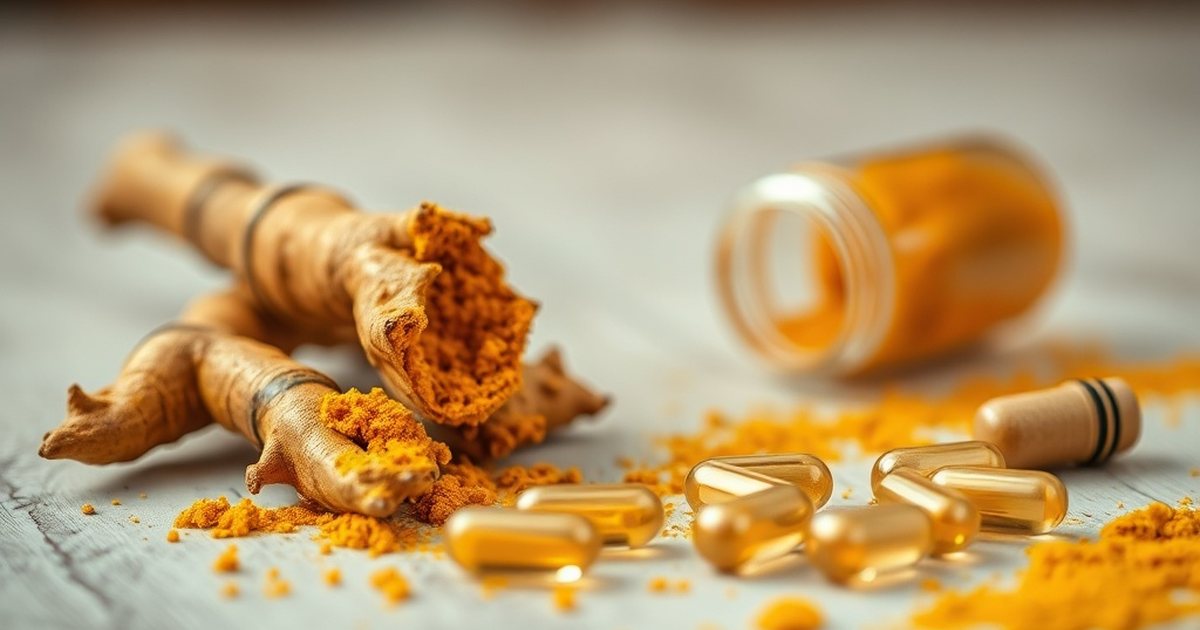

Advances in Delivery: Nanocarriers and Hydrogels
Bioavailability remains a major hurdle; native curcumin has poor aqueous solubility and rapid metabolism. Nanoparticle formulations — liposomes, solid lipid nanoparticles, and polymeric micelles — have been engineered to improve skin penetration and sustain release. The β1‑integrin study found in fibroblast cell experiments that a 77 nm curcumin nanoformulation was more effective than a 50 nm one at increasing β1‑integrin expression and reducing apoptosis markers [4].
A recent preclinical study developed a curcumin‑loaded nanocomposite hydrogel dressing that accelerated infected wound closure, promoted granulation tissue formation, and reduced bacterial load in a murine model [8]. While promising for wound care, translation to everyday anti‑aging skin products requires human safety and efficacy data.

Practical Considerations for Perimenopausal Women
Typical oral curcumin supplements provide 500–1,500 mg of curcuminoids per day, often combined with piperine or lipid‑based carriers to boost absorption. A Polish review notes that turmeric has a long culinary safety record, but high‑dose extracts can cause gastrointestinal upset, interact with anticoagulants, and affect cytochrome P450 enzymes [9]. Women on hormone therapy, blood thinners, or with gallbladder disease should discuss supplementation with a healthcare professional.
Topical products vary widely in curcumin concentration (0.1–2 %) and vehicle; those employing nanotechnology or liposomal encapsulation may offer better dermal delivery but lack long‑term safety data. Because the evidence for visible anti‑aging benefits in perimenopausal skin is still emerging, a sensible approach is to prioritize proven skin‑care fundamentals — broad‑spectrum sunscreen, moisturization, and a balanced diet — while viewing curcumin as a complementary, not primary, strategy.
References
- Collagen, Curcumin, and Glutathione to Enhance Dermal Health in Aging Women with Declining Estrogen Levels -A Narrative Review. Dermatology and therapy, 2026
- Effects of Turmeric (Curcuma longa) on Skin Health: A Systematic Review of the Clinical Evidence. Phytotherapy research : PTR, 2016
- Curcumin: a potential anti-photoaging agent. Frontiers in pharmacology, 2025
- The impact of the particle size of curcumin nanocarriers and the ethanol on beta_1-integrin overexpression in fibroblasts: A regenerative pharmaceutical approach in skin repair and anti-aging formulations. Daru : journal of Faculty of Pharmacy, Tehran University of Medical Sciences, 2019
- Immunomodulation with AM3 and antioxidants creates an adequate framework for skin repair and decreases the monocyte proinflammatory stage in smoker women. Biomedicine & pharmacotherapy = Biomedecine & pharmacotherapie, 2024
- Curcumin and ustekinumab cotherapy alleviates induced psoriasis in rats through their antioxidant, anti-inflammatory, and antiproliferative effects. Cutaneous and ocular toxicology, 2022
- Use of Curcumin in Psoriasis. Open access Macedonian journal of medical sciences, 2018
- Curcumin-Loaded Nanocomposite Hydrogel Dressings for Promoting Infected Wound Healing and Tissue Regeneration. International journal of nanomedicine, 2024
- [Turmeric – not only spice]. Polski merkuriusz lekarski : organ Polskiego Towarzystwa Lekarskiego, 2017
These statements have not been evaluated by the Food and Drug Administration. This information is not intended to diagnose, treat, cure, or prevent any disease. Content is for informational purposes only and is not medical advice; consult a qualified healthcare provider before starting any supplement. As an Amazon Associate we earn from qualifying purchases.
