Affiliate disclosure: As an Amazon Associate, this site earns from qualifying purchases linked in this article.
Turmeric has been used in cooking and traditional practices for centuries, but the compound curcumin — often highlighted on supplement labels — is only one part of the root. Understanding the difference helps you make informed choices about what you’re actually getting.
This guide breaks down the chemistry, extraction, and research behind curcumin and turmeric, with a focus on what the evidence says so you can decide what fits your needs during midlife and beyond.
Turmeric Root vs. Curcumin: What’s the Difference?
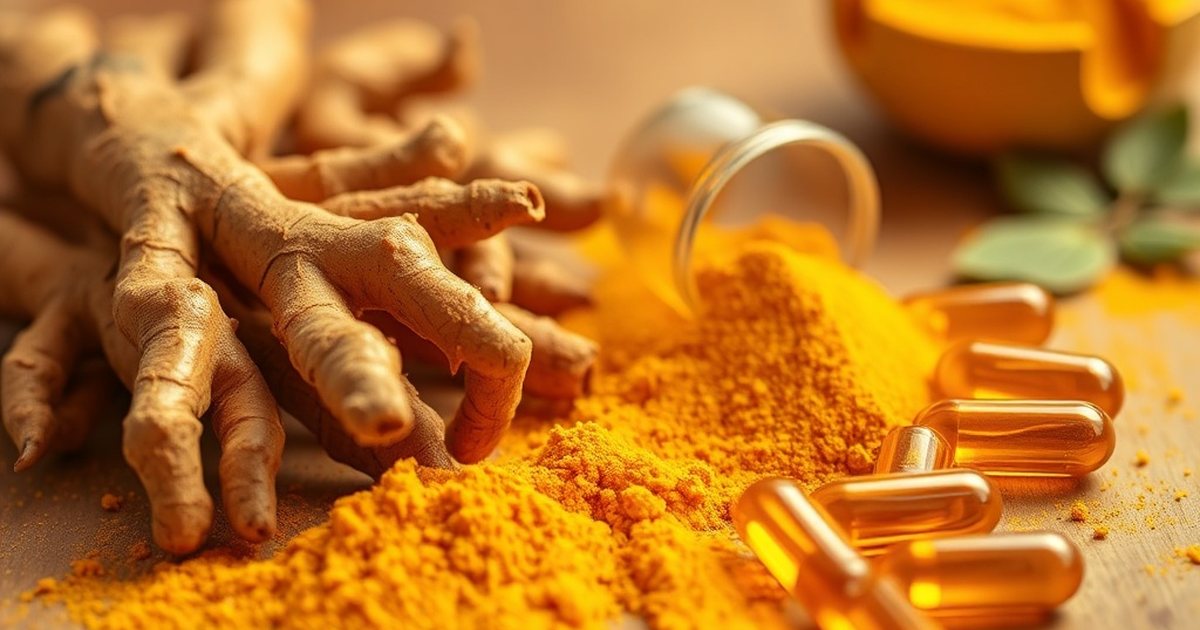
Turmeric (Curcuma longa) is a rhizome — a root-like stem — that contains a family of compounds called curcuminoids. Curcumin is the primary and most studied curcuminoid, typically making up 2–5% of the dry weight of turmeric root [1]. The remainder includes other curcuminoids (demethoxycurcumin and bisdemethoxycurcumin), volatile oils, proteins, fibers, and minerals.
When you use ground turmeric in cooking, you’re getting the whole root powder with all its components in their natural ratios. Curcumin supplements, by contrast, are extracts that concentrate the curcuminoids — often to 95% purity — removing the oils, fibers, and other constituents [2]. This distinction matters because the dose, absorption, and effects can differ substantially between the whole spice and an isolated extract.
How Curcumin Is Extracted and Standardized
Commercial curcumin extracts start with dried turmeric rhizomes. Solvent extraction (commonly ethanol, ethyl acetate, or supercritical CO2) pulls out the curcuminoids, which are then purified and dried into a powder [1]. The resulting material is typically standardized to contain a minimum percentage of total curcuminoids — most often 95% — with curcumin itself comprising roughly 70–80% of that total [3].

Standardization aims to deliver a consistent amount of active curcuminoids per dose. However, extraction methods vary, and some processes may leave residual solvents or affect the ratio of the three main curcuminoids [3]. Third-party testing for purity, heavy metals, and solvent residues is a practical way to verify product quality.
Bioavailability: Why Absorption Matters
Curcumin is poorly absorbed on its own. After oral ingestion, it undergoes rapid metabolism in the gut and liver (glucuronidation and sulfation), leading to low plasma concentrations of the free (unconjugated) form [2]. This has driven extensive research into delivery systems designed to improve bioavailability.
Strategies include combining curcumin with piperine (from black pepper), which inhibits metabolic enzymes; formulating with lipids or phospholipids (as in phytosomes); and encapsulating in micelles, nanoparticles, or microemulsions [3]. These approaches can increase the area under the curve (AUC) for total curcuminoids by several-fold to over 20-fold compared with unformulated curcumin, though the relative increase in free curcumin varies [3].

What Research Shows About Curcumin’s Properties
Curcumin has been studied for antioxidant and anti-inflammatory activity, largely attributed to its β-diketone structure and phenolic hydroxyl groups that can scavenge free radicals and modulate signaling pathways such as NF-κB [4]. These mechanistic findings come primarily from cell and animal models.
In human trials, curcumin extracts have been evaluated for conditions involving inflammation. A systematic review and meta-analysis of randomized controlled trials found that curcumin and Curcuma longa extract improved pain and function scores in arthritis, with a safety profile comparable to placebo [5]. Research has also explored curcuminoids as adjunctive support in inflammatory bowel conditions such as Crohn’s disease and ulcerative colitis [6], and investigated metabolic effects relevant to type 2 diabetes [7]. Most trials use formulated curcumin (enhanced bioavailability) at doses of 500–1,500 mg of curcuminoids per day.
Safety Profile and Known Considerations
Turmeric and curcumin are generally regarded as nontoxic and safe at dietary and supplemental doses [8]. Clinical trials have used up to 8–12 g/day of curcuminoids for limited periods with mostly mild, transient adverse events such as gastrointestinal upset, nausea, or diarrhea [2].

However, curcumin can interact with certain medications. It inhibits cytochrome P450 enzymes (notably CYP3A4 and CYP2D6) and may affect drugs metabolized by these pathways, including some anticoagulants, antidiabetics, and chemotherapy agents [2]. People with gallbladder disease, kidney stones, or iron deficiency should use caution, as curcumin may stimulate bile contraction, contain oxalates, and chelate iron [8].
Choosing a Product: What to Look For
If you opt for a curcumin supplement, prioritize products that disclose the curcuminoid content (ideally 95% standardized), the delivery technology used (e.g., phytosome, micelle, piperine-complexed), and third-party testing for identity, potency, and contaminants [3].
Whole turmeric powder remains a culinary option that provides the full matrix of the root, including volatile oils and fiber, though the curcuminoid dose per teaspoon is modest (~50–100 mg) [2]. Some women prefer incorporating turmeric into meals with fat and black pepper to modestly enhance absorption, while others choose a standardized extract for a consistent, higher curcuminoid intake. Both approaches have a place depending on your goals.
References
- The chemistry of curcumin: from extraction to therapeutic agent. Molecules (Basel, Switzerland), 2014
- Curcumin, an active component of turmeric (Curcuma longa), and its effects on health. Critical reviews in food science and nutrition, 2017
- Curcumin: Overview of Extraction Methods, Health Benefits, and Encapsulation and Delivery Using Microemulsions and Nanoemulsions. International journal of molecular sciences, 2023
- An overview of structure-activity relationship studies of curcumin analogs as antioxidant and anti-inflammatory agents. Future medicinal chemistry, 2017
- Efficacy and Safety of Curcumin and Curcuma longa Extract in the Treatment of Arthritis: A Systematic Review and Meta-Analysis of Randomized Controlled Trial. Frontiers in immunology, 2022
- Curcuminoids from Curcuma Longa: New adjuvants for the treatment of crohn’s disease and ulcerative colitis?. Critical reviews in food science and nutrition, 2019
- Food Polyphenols and Type II Diabetes Mellitus: Pharmacology and Mechanisms. Molecules (Basel, Switzerland), 2023
- Turmeric (Curcuma longa) and its major constituent (curcumin) as nontoxic and safe substances: Review. Phytotherapy research : PTR, 2018
These statements have not been evaluated by the Food and Drug Administration. This information is not intended to diagnose, treat, cure, or prevent any disease. Content is for informational purposes only and is not medical advice; consult a qualified healthcare provider before starting any supplement. As an Amazon Associate we earn from qualifying purchases.
